Our first case study is more of an origin story than a success story.
By late May 2026, I realized that everyone was focused on AI citations, links, and quotes in search results, but none of that made sense or added value. The real opportunity in AI search is to leverage the agent’s ability to guide customers from research through analysis and comparison to a final recommendation, all within a single closed‑box experience with their favorite chatbot.
I also learned that AI generates answers by conducting hyperscale research and then returning an analysis of that independent work. If you ask AI for a simple recommendation, it may run 20–30 separate Google searches to bring those insights back. A human might type a single sentence into Google, but the same question to an AI agent triggers extensive research. AI agents read dozens of pages faster than Commander Data ever could (from StarTrek™).
What phrases do AI agents use when searching on behalf of a customer? How can you uncover those searches and develop strategies to ensure AI agents find your business among the sites and citations they cite to build a case for your brand?
In traditional SEO, we focused on keywords tied to each stage of the buyer’s journey, awareness, comparison, and conversion. With AI recommendations, the process is simpler: you’re essentially asking whether AI will mention your brand unprompted and then go further to recommend it to the customer.
Programate Lift began as a homebrewed project to create a system that lets me conduct this research for my business, Fountain City.
Fountain City is a small company that has never exceeded 24 employees, the peak we reached in 2024. Since I founded the business in 1998, we have primarily obtained work through referrals, word of mouth, and network connections.
When I began this research in early June 2026, our SEO and AI search pipeline was essentially nonexistent, producing almost no qualified, non‑referral leads each week.
2025 was a particularly hard year for the business because we pivoted into AI, only to discover that most companies remained extremely hesitant to start projects. By June 2026, I was especially motivated to jump‑start our lead pipeline.
Below are the initial test results. Despite posting 3–5 blog posts per week for several months and guest appearances on numerous podcasts and speaking events in 2024 and 2025, we weren’t mentioned at all in searches. Even with that volume of content, AI still didn’t recognize us as a brand to recommend to prospective buyers, either nationwide or locally in our hometown.
Below is the initial baseline I started with. You can see I formulated three different buyer questions, and I analyzed which companies were top of the list. The results are a mixture of companies and platforms.
June 5th 2025
| Buyer question (exact wording) | Named instead of Fountain City |
|---|---|
| “I have an idea for an AI agent that does customer onboarding for my coaching business. Who builds these? Like actually builds them, not just consults?” | MindStudio, OpenClaw, LiveChatAI, Botpress, Chatbase, Ethora |
| “I want an AI agent that does lead qualification for my marketing agency. Who actually builds these end-to-end, not just sells me the tools?” | Revenue Institute, Scalevise, ALM Corp, Yinovise |
| “I am looking for a company or educator that can help my team of developers to learn how to use claude code effectively. I am looking for an agency, not a large company. We are about 20 people in size.” | Infralovers, KIBO |
On June 5, I began testing a persona I created called the Visionary Founder. Its goal was to find an AI agency in Portland. I programmed the persona to ask an AI model a series of questions, starting with, “Which vendor in our geographic area would be the best company to hire?” The persona could ask follow‑up questions until it received a satisfactory answer (a recommendation of an agency, whether ours or a competitor).
| # | Buyer asked | Ranked | Fountain City | Searches Perplexity ran (fan-out) |
|---|---|---|---|---|
| 1 | “Recommend me an AI agency close to me in Portland, OR.” | 1. PDX Intelligence 2. Idealist Consulting 3. Media Mechanic 4. Northwest AI Consulting | Not mentioned | “AI consulting agency Portland Oregon” “AI development services Portland OR” “machine learning consulting firm Portland OR” |
| 2 | “Okay those are helpful starting points, but I need you to get more specific — which one of those would you actually point me to first if I told you I want a team that will build me something completely custom that I own outright, not plug me into someone else’s platform or subscription? Like, who’s the best fit for that kind of build-it-from-scratch engagement?” | 1. PDX Intelligence 2. Northwest AI Consulting | Not mentioned | “Northwest AI Consulting custom AI development Portland” “PDX Intelligence custom AI development Portland” “Portland AI agency custom software ownership from scratch” |
My initial testing was done using Perplexity and Claude. From the analyzed process, I could see what the underlying logic was that was helping them to derive their answers. Using this, I was able to piece together exactly where they went, how they searched, how they thought, and what they did to build their recommendations.
The insights indicated a mix of direct improvements to pages on our website we needed to edit, and those that we needed to develop on external sites.
The research insights gave me a concrete list of pages and blog posts I needed to edit, update, and augment. Below, you can see the three pages that I either changed or added to the website:
June 7th
| Time (PDT) | Change |
|---|---|
| 11:18 AM | New page published: “AI Agency in Portland, Oregon” (/ai-agency-portland-oregon/), last edited 11:57 AM |
| 11:33 AM | Page updated: “AI & Digital Transformation Consulting for Oregon Manufacturers” (/digital-transformation-consulting-portland-oregon/) |
| 12:02 PM | Blog post updated: “AI Consulting Portland Oregon — How to Choose the Right Partner” (/resources/blog/ai-consulting-portland-oregon/, originally published March 16). The title was changed to match the fanout query that AI agents were using: “AI consulting agency Portland Oregon”). |
What surprised me was how quickly the results arrived. I usually expect SEO to take three to six months before any results appear, yet here the AI’s recommendations changed within a couple of hours.
We went from not being mentioned at all to the top recommendation in Portland, Oregon in just two days of work. It was so easy, it felt magical.
Two days later, we ran the same three scenarios, and this time, each of the three scenarios now mentioned Fountain City in the top three positions:
June 7th
| Run | Result | Ranked |
|---|---|---|
| 1:16 PM | Not named in the first answer; #3 on the follow-up | Follow-up: 1. Olio Apps, 2. Twenty Ideas, 3. Fountain City, 4. Singlemind, 5. Synaptiq |
| 1:17 PM | #1 | 1. Fountain City, 2. The Automators, 3. PDX Intelligence, 4. SLIDEFACTORY, 5. Media Mechanic |
| 1:17 PM | #1 | 1. Fountain City, 2. The Automators, 3. PDX Intelligence, 4. SLIDEFACTORY, 5. Media Mechanic |
Once we put these changes in place, Perplexity started recommending us immediately:
“Fountain City – Portland-based AI agency focused on custom AI agents, automation, and RAG systems for mid‑market and enterprise teams. They design, build, and run production AI systems end‑to‑end and list a direct Portland contact number for consultations.”
“Fountain City (AI agents & automation): Portland-based AI agency focused on building and running custom AI agents, automations, and retrieval-augmented generation (RAG) systems for mid-market and enterprise teams.”
“Fountain City, Inc. (Portland, OR) – Provides AI development, AI agents, and custom software and has been around since the late 90s. Their mix of AI consulting and full custom builds makes them a strong candidate if you want a proprietary tool rather than a generic automation stack.”
Perplexity’s 1:17 PM answer cites the blog post we updated at 12:02 PM (fountaincity.tech/resources/blog/ai-consulting-portland-oregon/), alongside the homepage.
The pattern repeats (June 8–18, 2026)
Between June 8th and 18th, each time I discovered a new nuance that required a different strategic approach, I isolated the cause of the missing recommendation and, through retesting, determined how to secure the top recommendation position.
I then repeated the process with additional models and key phrases, designing the workflow around more tests and queries. Each time I identified a new factor contributing to the AI giving or not giving a recommendation, I isolated the cause and, through retesting, discovered how to dominate the number‑one position.
| When | Miss | Models tested | Initial result | After |
|---|---|---|---|---|
| June 8 | I am looking for a public speaker in Portland Oregon who is a thought leader in AI | Perplexity | Absent | ChatGPT recommended on June 11th |
| June 10 | Recommend for me a good agency to help build a custom saas application for our business | Gemini, ChatGPT, Perplexity, Claude | Absent | Not rerun, switched to geo-local |
| June 11-18 | Recommend me an AI agency close to me in Portland, OR. | Gemini, ChatGPT, Perplexity, Grok | Absent | #1 in all 9 runs |
At first, I tried a mix of optimization for speaking events, national, and geo‑local recommendations. A local recommendation proved easy to dominate because the keywords have almost no difficulty in your geographic area compared to the same keywords on a national scale. We would have pushed for a national general keyword target, but with such a small agency, 2–3 qualified leads a week are more than enough for us to thrive.
“We don’t need to be a big fish in a big pond; we just need to be a big fish in a small pond.”
You still need to consider the difficulty of the pond size you’re targeting. In other words, you can work hard to get an AI recommendation, but if 10,000 companies are competing for the same position, you’ll still struggle, no matter how much data and insight you have.
I’m a big fan of finding a niche with about ten competitors. Geolocation is an easy niche to target if your services are unique enough to attract a large customer base while competition stays around ten or fewer.
With this in mind and with the excellent results I was getting, I thought that it really made sense to build this out into a tool so that others could also benefit from it. At the time, all the other major GEO, AEO, and AI search tools were still overly focused on citation and AI visibility, but here I was with a tool that directly helped me to get AI to generate an actual recommendation.
From there we invested a lot of time building a fairly extensive application: the website you see today, Programate Lift.
Initially, we were not measuring reputation or alignment, and questions weren’t being generated. We began with the essential core, a persona, a goal (i.e., a question to answer), a model to test against, and critical strategic insights to help you get your brand recommended.
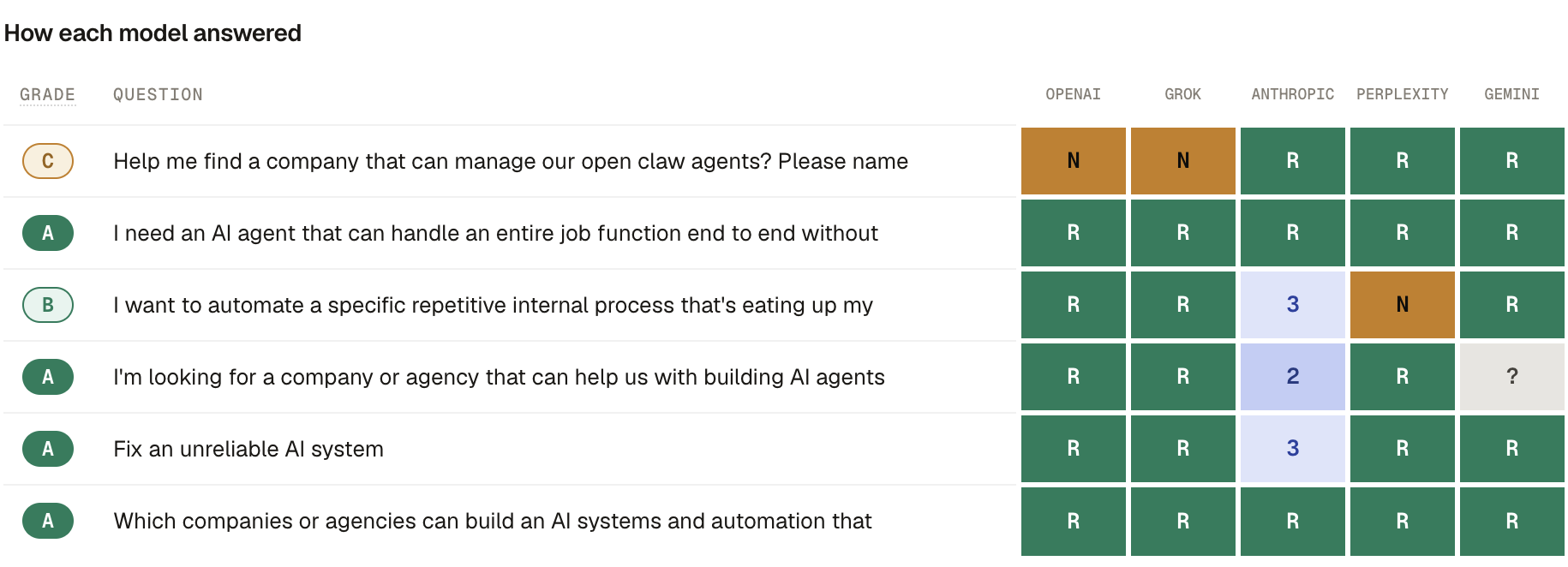
Below, you can see some of Fountain City’s newest score results on the tool. We continue to rank with a pretty high score (Initially, with our core goal set, we were scoring above 96%), but as we added new goals we wanted to test against, those have also pulled our overall score down:
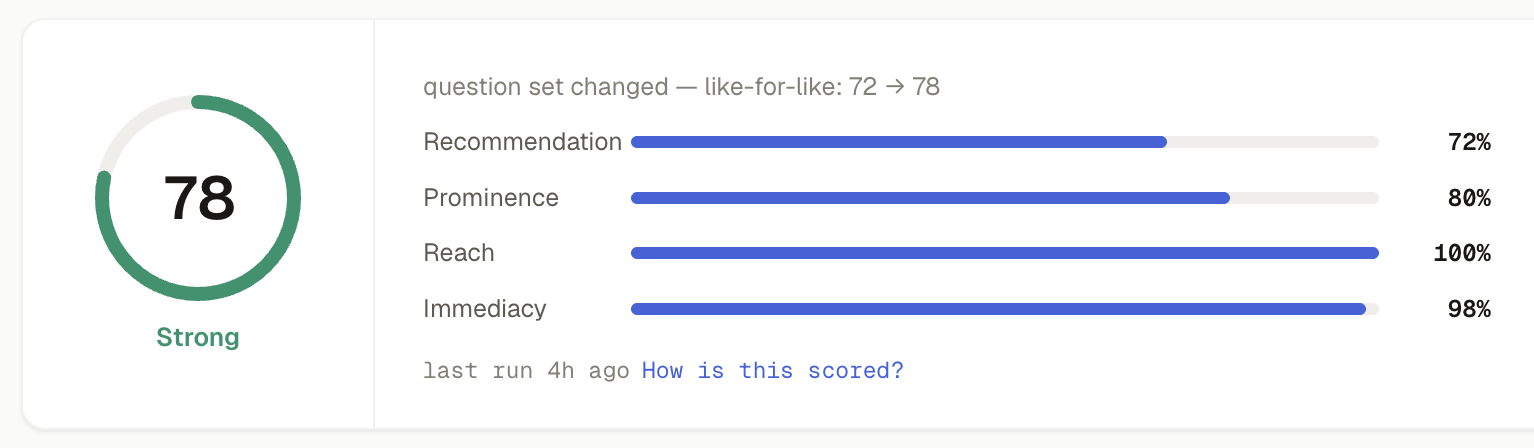
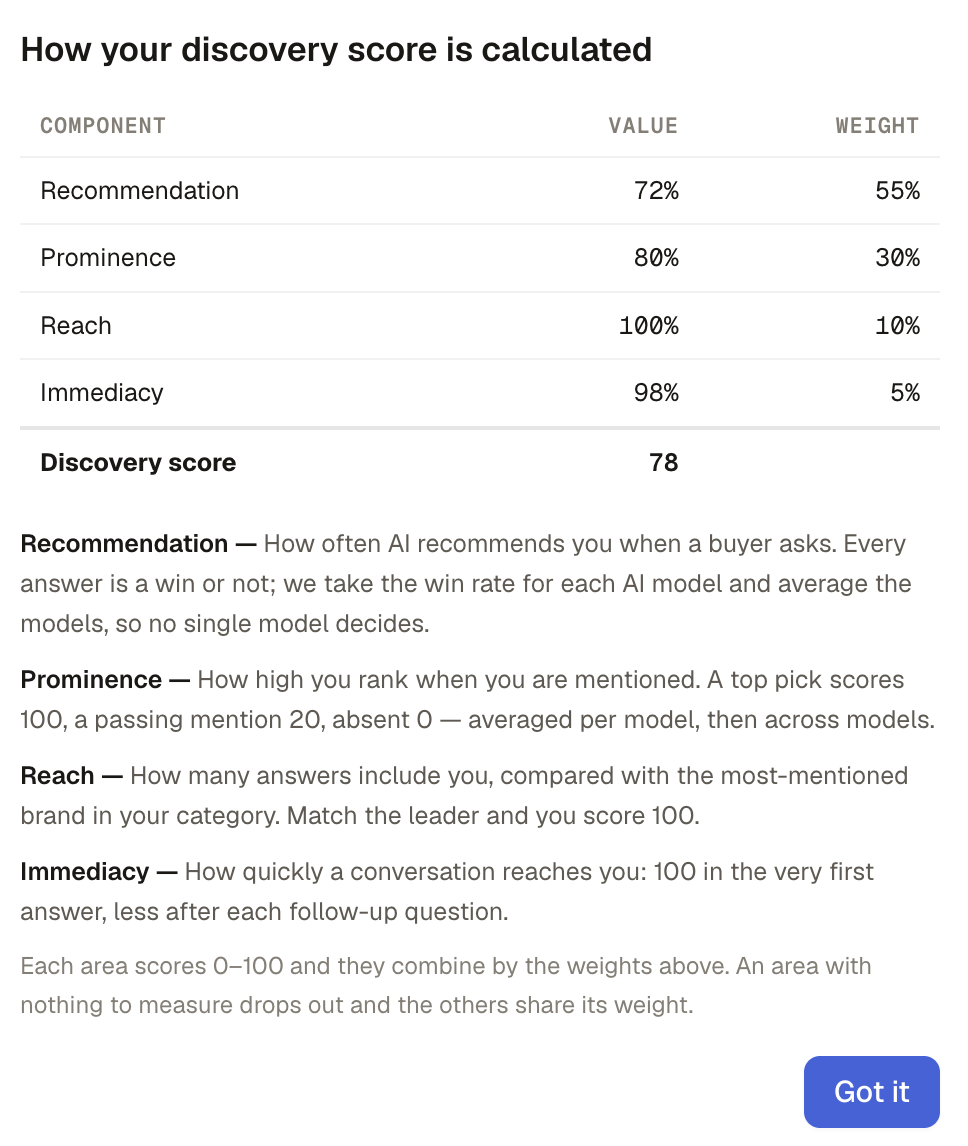
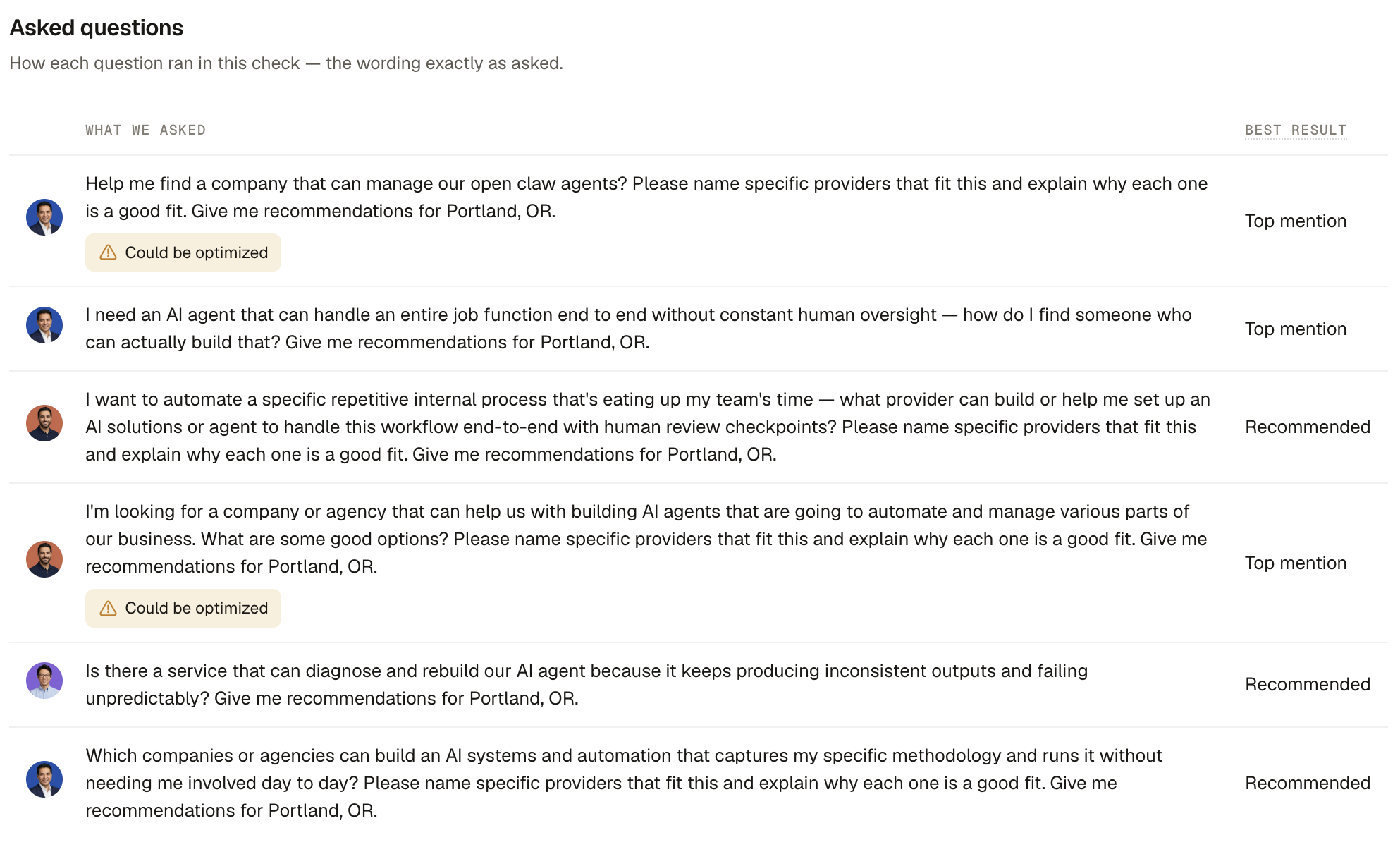
As you can see on these images more recently, we’ve also started adding OpenClaw as an additional target. We’re not quite getting first position on recommendations across the board yet, but since this is new, it’s still in progress, and we expect this to improve further.
We may continue pursuing our position on open-claw recommendations, or pivot as new niches and subdomains within the AI agentic economy evolve.
The table below provides a detailed view of our performance on each of the six core questions we are tracking.
Results
The results have been substantial. We went from starving for leads in 2025 to having more leads than we can handle in 2026.
Lead flow has slowed in October (about two leads a week), but it held steady at three leads per week for months during the summer.
In the past few months we’ve landed some of our best clients, and they’re in the exact service and skill areas where we want to shine and deepen our expertise.
Selling your services is much easier when customers find you through a recommendation for something you love to do and arrive with that recommendation in hand.
When we relied on referrals, even the best clients were often not closely aligned with our core expertise.
I would love to hear from you and see how it also helped you to deliver great results.